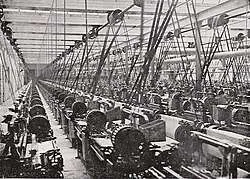
The Fence Goes Up After the Injuries
In 1855, a group of mill owners in northern England formed a National Association of Factory Occupiers. It aimed to fight an eleven-year-old law that required them to put guards around their spinning shafts and gears. The association’s committee recommended raising at least £ 5,000 to cover the penalties and legal costs of any member prosecuted for ignoring it. In today’s money, £5,000 from 1855 is about £699,000 in 2026, or roughly $900,000.
Working around laws
To see how it got there, start in 1833. That year, Britain’s Factory Act created the first factory inspector jobs, four of them, for a country full of mills. The Act was widely evaded, since there were so few inspectors and so many factories.
In 1844, another Factory Act went further. It required fencing dangerous machinery and reporting serious accidents to a surgeon for investigation.
Then came 1855, the year the owners organized. In April, Henry Morley wrote in Household Words, the weekly journal Charles Dickens edited, that the inspectors had counted more than 2,000 accidents in six months. Only about 100 fell outside what the law already required owners to prevent. Nearly all the rest involved machinery that should have been fenced, and twenty-one people were killed by machinery in those six months. (Morley wrote as an advocate and the owners disputed his framing, so lean on the count: it came from the inspectors.)
In 1856, under pressure from owners, Parliament eased some of the requirements of the 1844 Act.
The same fight, with AI
AI regulation is in its own early chapters, and the beats look familiar. In 2024, Colorado passed the country’s first comprehensive state AI law. Business groups raised concerns about compliance costs, and a White House executive order directed the Justice Department to challenge state AI laws in court. In April 2026, a federal court stayed enforcement of the Colorado law while lawmakers rewrote it. In May, Colorado replaced it with a narrower law that starts in January 2027.
Europe has had its own version. The EU AI Act’s rules for high-risk systems, such as AI used in hiring and credit scoring, were due August 2, 2026. In July, the EU moved that date to December 2027, saying the technical standards and national regulators needed to apply the rules were not ready. Meanwhile, California, Texas and Illinois each have AI laws that took effect on January 1, 2026.
Supporters of the delays point to compliance costs and unfinished standards. Critics argue that delay and federal preemption leave people with less protection. Either way, the pattern matches the mills: a rule gets passed, someone contests it, and the rule changes shape.
A fence people climb over
This is where it reaches your office. Some company AI policies exist because of laws like these, or because a customer asks about one. That means the policy inherits the same fight, only it plays out one desk at a time. The review step gets skipped when the deadline hits. The approved tool gets bypassed for a faster one. The sign-off turns into a click. The binder says one thing and the floor does another, and a fence people climb over is not a fence.
So ask the floor questions. Who reviews what the AI produced before it goes out? Who can shut it off? Who picks up the phone when a fake video of your CEO lands in a customer’s feed? (If the answer is “we’d figure it out,” your fence exists only on paper.)
In the mills, the injuries came first, then the rule, then the fight over enforcement. With AI, we still have a chance to move up the line and find the gaps before someone stands next to the machine.
Rehearse before the injury
Finding a hole in your fence is a lot cheaper on a practice day than on a real one. That is the idea behind The Agentic Crisis: A Free AI & Deepfake Crisis Simulation, a free AI crisis simulation from our Strategic Insights Center.
It runs online on Thursday, November 5, from noon to 1:30 pm ET. You join a team running crisis response for a fictional credit union and work through three fast-moving rounds. Could your team handle a deepfake of your CEO, a rogue AI assistant, and a ransom demand in one afternoon? Find out with no real-world stakes and no technical experience required. Every player gets our AI and cyber crisis management whitepaper, and each team takes home a Crisis Readiness Scorecard. If you work in communications, marketing, nonprofit leadership, or public service, this one is built for you.
Register here: https://www.eventbrite.com/e/the-agentic-crisis-a-free-ai-deepfake-crisis-simulation-tickets-2002569468187?aff=oddtdtcreator
Two questions before you go. Who built the fence around your AI use, and did the people closest to the machine have a say? And when did your team last practice the worst day?
Ebony Vaz (Head of Musings at Above Promotions)
Subscribe to From Lab to Desk to receive bi-weekly musings on technology from creation to use.
Sources
- Household Words, “Fencing with Humanity” (April 14, 1855)
- Household Words, “Death’s Cyphering-Book” (May 12, 1855)
- Household Words, “Our Wicked Mis-statements,” quoting the owners’ £5,000 fund
- History of Occupational Safety and Health timeline
- Designing Buildings, Factory Acts
- Archives Hub, Association of Certifying Factory Surgeons
- The Agentic Crisis on Eventbrite

